Series: Big Tech Alternatives
tl;dr: Some first positive impressions about a Canadian social media effort.
There's a new Canadian social media app: Gander Social. Seriously. This may be the first one ever that seems to have some sustainable momentum, not counting Canadian implementations of open source projects like Mastodon Canada. This is new software made in Canada, by Canadians, for Canadians, moderated in the spirit of the Canadian Charter of Rights and Freedoms. They're leaning fully in on the current "Buy Canadian" moment.
I recently got into the beta and have some notes about my early impressions. In short: it's definitely a rough beta in some ways, but it has a lot of the right ideas.
The Front Page
The mobile app - which is the only gateway at the moment, with no web version - is very clean and friendly to use, except for the front page and navigating between feeds. For reasons I cannot discern, when I first open the app, I do not see my main feed, or any obvious way to select between different feeds.
First, I see posts from my "nest" which is meant to be an inner circle of users I really care about seeing everything they post. At this point I haven't really decided who should be in that because I don't know very many people with an account. That view appears with big squares, which might be nice if they are photos, but is very weird when they aren't, with a few words that are then cut off against a blank background.
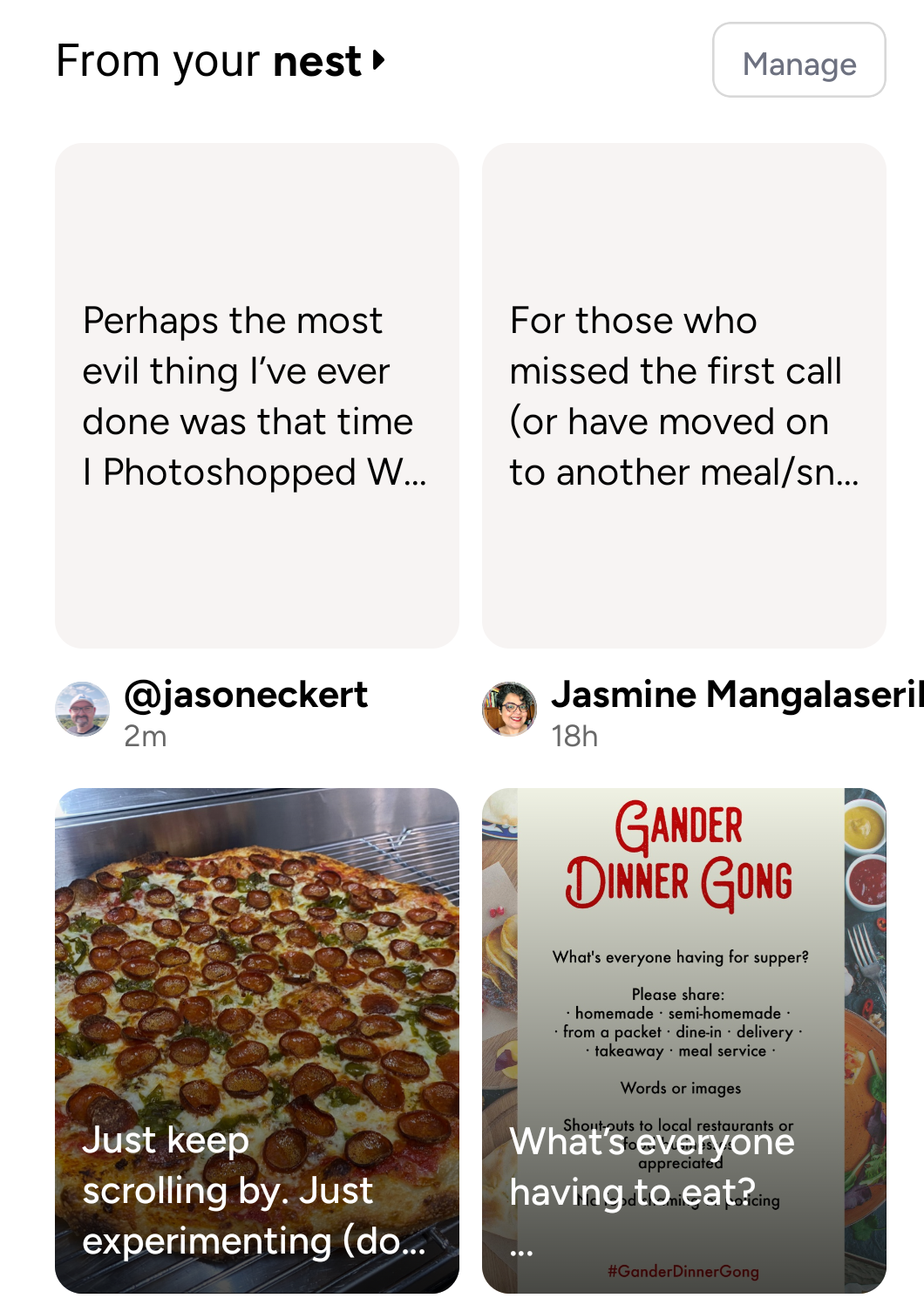
Then, I see a group of "People you may know" which is always the same set of users every time I open the app. That immediately makes me ask myself again each time why I opened this app, which is not the thing you want your users to be asking when they first open your app. This used to be first, above even the nest, which made an even worse first impression.
Continuing down the front page, now I'm back to seeing more people to follow, but this time split up by very broad topics "based on your interests." Why do we have two sections of recommended follows on the front page? Why is it mostly the same group of users every time? How do they even determine who fits what topic category? I wish I could just open the app and see a default feed of my choice, which for me usually is "everybody I am following."
This truly is my biggest "what are they even doing here" issue so far.
The Feeds and Profiles
Once I then click on the Feeds button that probably should be the default, that next default is simply labelled "Feeds" and it isn't clear what it is. There are lots of people I don't follow, but the posts are quickly too old to be simply a firehose of all posts on Gander and on Bluesky (more on the Bluesky integration below). So there's another scrolling over, past buttons for "On Gander" and "Your Nest" to find the one I really want to start with: "Following." Now I can finally see the people who I have decided to follow, and I start to have more positive things to say.
Aside from that strangeness of switching between feeds, it's really clean and friendly to use. It's at least as nice as Bluesky and much nicer than any Mastodon app I've tried.
You can click on the expanded menu dots beside a profile and follow or unfollow, share, mute, block, or report post. I have tried muting already, mainly because of some sports betting stuff showing up in the firehose(?) feed, and that seemed to work flawlessly. I haven't tried blocking or reporting.
You can also view a profile in full. This gives you a fairly typical social media profile view, with an image, bio, following stats and links, and their feed of content. In this case, the feed of content is nicely divided between Posts, Flicks, Replies, and Boards. Flicks are the short videos. It's interesting that those get separated out in a way that images and links don't. Sometimes, especially if I am looking at an account like a journalist, I want to filter quickly to the links they've shared, and that isn't currently possible. Boards I'm guessing is to let creators cluster their posts together, like I could have a board for all my cat photos, but I haven't figured out how to add something to a board at this point - maybe it's a work in progress.
Back to viewing the items in feed, there are two other big features that I most want to praise.
News labels are the unequivocal win. These identify a link along two axes: what is the political bias, and how based in fact is this publication? For example, Toronto Star is usually marked as Centre-Left and with High Factuality. The Beaverton, the satire site, is marked as Mixed Factuality and Satire, which helps people from falling for believing it is actually meant to be news. These labels come from a neutral third party, not from Gander moderators. A lot of the big corporate networks would never add something like this, because they'd be constantly having to fight off extreme content providers who don't like being labelled for what they are. I think it's a good indication of the moderation philosophy that they are willing to have these labels, and it is genuinely useful information with unknown sites.
AI labels are also a win, although I wonder how effective they'll be if it doesn't maintain a culture of people using them. It does also run into the problem of "what counts as AI?" I suspect most people mean "all I did was a quick prompt and it gave me an image or longer text." But the lines get fuzzy quickly from that all the way down to using a machine learning spell check while you were writing an article that you now are sharing a link to.
Creating Posts
Currently you can create content in four categories:
- Text
- Images
- Short videos
- Shared links
There is a strong prompt when adding an image to include ALT text. That's better than a lot of sites. I'd love to see them go even a step further, like Drupal now where you need to either specify ALT or say it is decorative. You can still make wrong decisions, but you can't simply forget with that approach.
ATProto and Bluesky
Gander is built on ATProto, the open protocol developed by Bluesky. Currently, this means I can follow Bluesky users from it. So far I can't follow Gander users from Bluesky, and if I comment from Gander on a Bluesky post, Bluesky users cannot see it. It's a similar one-directional relationship as between Threads and ActivityPub at this point, although I'm a little more optimistic that Gander will get around to completing the integration than I am that Meta will ever feel motivated to make Threads truly open.
This protocol brings some significant benefits.
You have control over your feeds and your identifier, not at the mercy of what makes a US tech giant money. If you are unhappy with Bluesky but love Gander, you can move your account, with all your data, to a different service. I have not tried this in the way that I have tried moving between Mastodon servers - which is good enough but far from perfect - but I know this was always a big priority for the development of the protocol so I am optimistic this version will be even better.
It also includes a lot of other good ideas that are in Bluesky but not in Gander. I am waiting for a few more of those features to be available before I can completely leave Bluesky and use only Gander as my ATProto presence:
- I need to be able to move my current followers and following
- I need to be able to move my username, which on Bluesky is the very convenient @ryanrobinson.ca using the domain name that I own
- I need my posts and comments from Gander to show up on Bluesky, not only vice versa
- Labellers and mute lists that can be subscribed to
Financing
How is this social media app going to be sustainable? According to their FAQ:
After our Beta launch, we may seek additional impact investment and support from Government programs where possible. Our main goal, though, is to reach sustainability early. That’s why we’re exploring a number of avenues for monetization, including subscriptions for additional features, shared revenue models with creators, and ethical forms of advertising where user control comes first.
Personally, I like the two tier approach. For casual users, there can be advertising if it is purely context based, not surveillance of individual users all over the Internet. For those more heavy users or who just really don't want to see ads, they can pay a reasonable fee for a subscription to an ad-free tier. I would almost certainly be one of those people in the latter group, at least if it gets to the point where it can fully replace Bluesky for me.
Age Verification
Gander has recently made some introductory moves around the movement of age verification. Age verification, at least as it is mostly constructed so far, is generally a bad idea founded in a moral panic that, like a lot of moral panics, does maybe have some grain of truth behind it before getting blown way out of proportion into creating counter-productive proposals.
Gander's recent blog on this is more generous toward the general idea than I would be. They do seem committed, though, that they will never take your ID themself. They will use a variety of other tools the best they can, including leveraging less private things that suggest you probably are an adult, like if you have a university or large work organization email address. Another approach that applies to me is cira.ca membership, for those of us who own .ca domains. Rarely do kids own .ca domains, or if they do, it's because their parents trust them to be doing things on the Internet. Depending on where panic-based legislation falls, those might be considered not good enough, and I am really not opposed to those.
They are also planning to integrate Canada Post's Identity+ verification process. This keeps the ID data out of Gander, where they only get a yes or no. They say they delete the data immediately from their servers, but there's still room for man in the middle attacks. I'm still not convinced that people should be forced to decide whether to take risks like that before they can communicate to anybody on the Internet. Even aside from that, it is inconvenient, requiring another app on your phone and putting your ID into that.
While part of me wishes they stood their ground refusing to play along with the moral panic at all, I get it that they needed to do something and what they have landed on is probably as good as it is going to get.
Conclusion
It still has some ways to go, mainly on that front page interface and finishing the ATProto integrations. If those happen, the promise of a Canadian social media organization, with adequate funding, on an open protocol that can integrate with the rest of the world without being controlled by one of those enshittifying companies... that's a compelling sales pitch and I'll be happy to go all-in on using it regularly.
If you are already in the beta, you can follow me at @ryanr.gander.social.
Previous: Traefik for Local Dev